

OPINION – In the Anthropology of Islam and Muslim Societies class, a lecturer quoted Shahab Ahmed’s thesis which states that Islam is composed of various contradictions. It seems that such idea can be justified by seeing that there is no single face when expressing Islam.
Moreover, we often acknowledge that there is no papal system as in the Catholic tradition, for example. With such a reality, the diversity of forms of Islam is an undeniable fact.
The diversity also can be understood as a result of the effort made an individual (exegete, jurist, theologian, and so on) to deal with religious texts, the Quran and hadith. These two canonical texts often provide meanings that are not vague, if not ambiguous, in several parts. Based on this ambiguity, the potential for differences between one school of thought and another is not just a figment of the imagination.
One of the most famous examples that illustrates how the reading of an ambiguous religious text can vary is the term “quru’” in the Qur’an. The term is related to the waiting period for a woman who has been divorced by her husband, which the Qur’an refers to as three “quru’.” Due to this ambiguity, School A interprets it as the period of menstruation.
On the other hand, School B offers a slightly different view, stating that the term means the period of purity. With this difference, it is clear that the waiting period for a woman who has been divorced by her husband can be three cycles of purity or menstruation, depending on which school one follows.
Based on such inconsistencies, the possibility of bringing forth new interpretations of Islam is always wide open. New critical readings, as offered by many contemporary Muslim thinkers, will always emerge in succession.
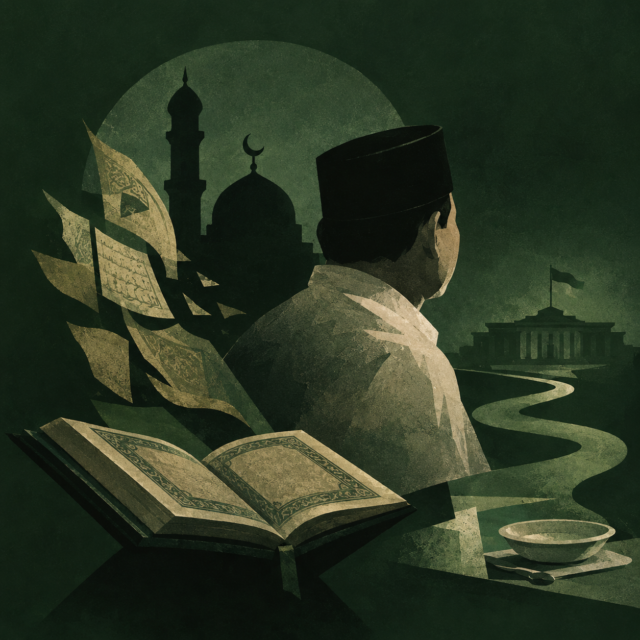
On this basis, when the book “Islam ala Prabowo” was published, the first thing that stirred me was not the content, but the possibility of justifying (validating?) it.
Regardless of the personal position that contradicts the figure being reviewed, it seems there is no choice but to reject it outright. However, as mentioned earlier, Islam is always open to various paths of reading and interpretation. What distinguishes such book from other intellectual works is that Prabowo did not write it himself, aside from epistemological issues. In fact, the book is nothing more than testimonials from his colleagues about how Prabowo embodies Islam.
This commotion is certainly not something entirely new. A decade ago, we were once stirred by a new slogan popularized by one of the largest Islamic organizations: Islam Nusantara.
In my opinion, what distinguishes Nusantara Islam from Prabowo’s Islam is the level of reliability and epistemological solidity. While the former relies on a rich tradition of the past, the latter variant is merely a personal reflection that, in some parts, appears forced. Especially when the names of several important figures come to the surface.
The hollow and seemingly forced content can be seen from several excerpts that state that the Red and White Regional Cooperative (KDMP) and Free Nutritious Meals (MBG) are manifestations of an Islamic spirit.
Nevertheless, such matters are validly offered, and it is the readers’ assembly that will judge and evaluate. The reason, as I have agreed from the beginning, is that Islam can never close itself off from the possibility of various interpretations—even the most deviant ones that contradict orthodoxy!
Therefore, when asked whether Prabowo and his colleagues are allowed to claim their version of Islam? I would firmly answer that it is permissible and very easy to justify it as exemplified above.
However, when the question is slightly shifted to the possibility of justifying whether MBG has an Islamic nuance or not, while at the same time thousands of students have been poisoned, it feels like it would take hundreds of times of thinking to justify that.
So, I completely understand Prabowo’s version of Islam, but when someone says all his policies have an Islamic nuance, I am the first to roll up my sleeves and shout, “I will fight back!”
Moh. Rofqil Bazikh, Master Student at Indonesian International Islamic University, Depok, West Java.